
Electrical Panels & Service Upgrades
Circuit Breaker Repair
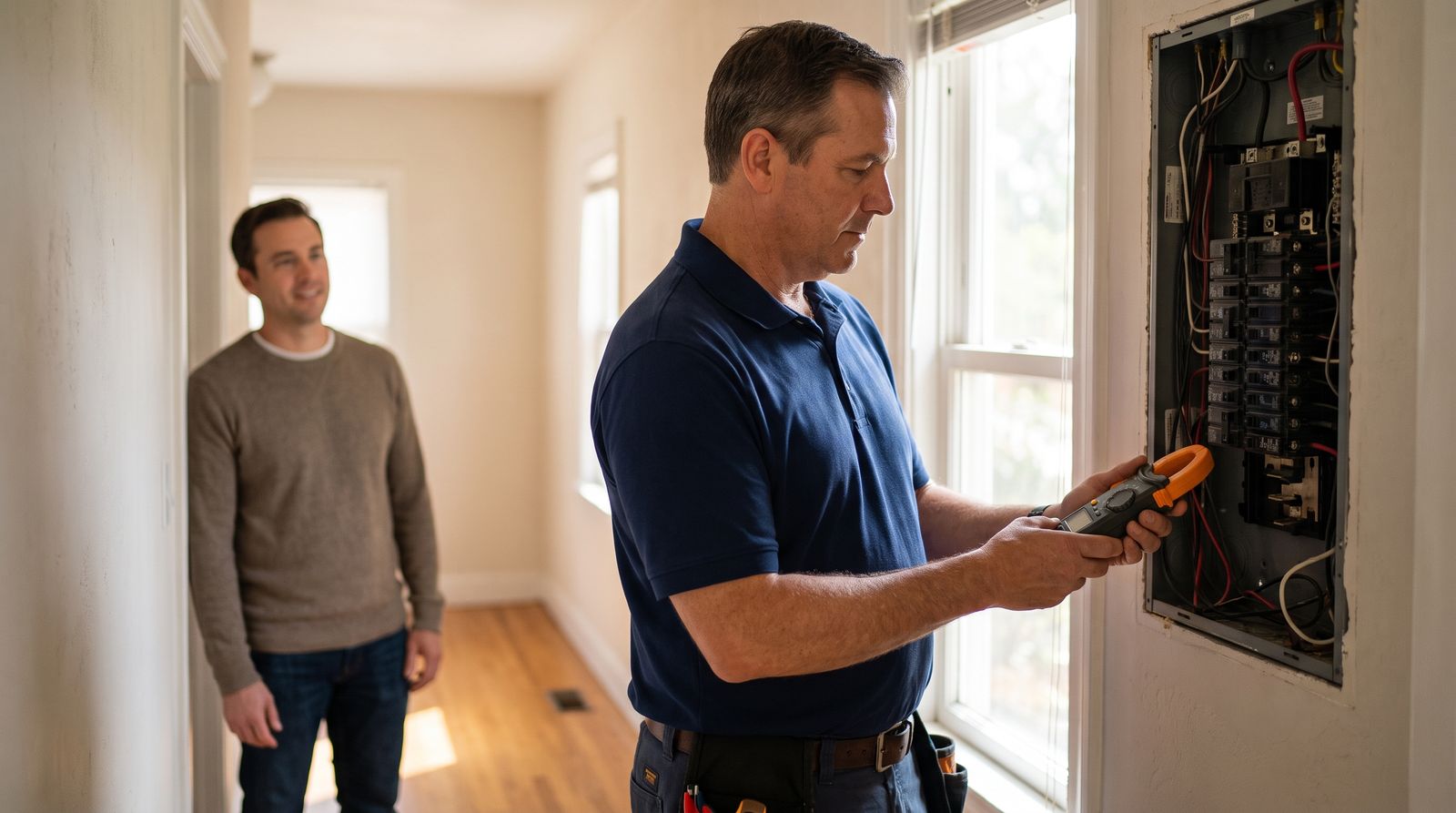
A breaker that trips repeatedly is doing its job — something is wrong on the circuit. We test the circuit under load, find the fault or overload, and repair the real problem rather than masking it.
Circuit Breaker Repair you can count on
A breaker doing its job is not a fault. It is a safety device reporting that something on that circuit is drawing more than the wiring can carry, and the honest first question is always whether it is the breaker or the thing behind it.
Three different problems present as "the breaker keeps tripping", and they need three different answers: an overloaded circuit, a fault on the circuit, or a breaker that has weakened with age and now trips below its rating. Testing distinguishes them.
What we will never do is fit a larger breaker to stop the tripping. That is the most common piece of bad advice in this trade. The breaker is sized to protect the wire; making it bigger does not raise what the wire can carry, it just removes the protection and lets the wire be the thing that fails instead.
What we handle
- Diagnosing repeated or nuisance trips
- Testing for shorts, overloads, and ground faults
- Replacing worn or failed breakers
- Re-terminating loose or burnt connections
Signs it is time to call
- One breaker trips regularly
- Points at that circuit — either genuinely overloaded, or a fault on it. Worth knowing which.
- It trips with nothing obviously running
- That is more likely a fault or a failing breaker than a load problem.
- It will not reset at all
- Usually the fault is still present. Repeated forcing is how a fault becomes a fire.
- A GFCI or AFCI that trips constantly
- Sometimes a genuine fault, sometimes an appliance with leakage, sometimes a device at the end of its life. Diagnosable, and worth diagnosing rather than bypassing.
- The breaker or its slot is warm
- Heat at a breaker means a poor connection at the bus or the lug. That one is not a wait-and-see.
How the job runs
- Establish what is actually on the circuitHalf of "mystery" tripping is a circuit carrying more than anybody realised, usually because something got added over the years.
- Measure the loadActual current under real conditions rather than an estimate from the panel directory.
- Test for a faultInsulation and continuity testing to separate a genuine fault from simple overload.
- Inspect the breaker and its seatBreakers wear. So do the bus stabs they sit on, and a poor connection there mimics a failing breaker.
- Fix the cause, size the protection correctlyRedistribute load, repair the fault, or replace the breaker like-for-like. Never up-size to silence a symptom.
What moves the price
We do not publish a flat number for work we have not looked at — a quote made from a web page is a guess, and guesses get corrected on invoice day. These are the things that genuinely change what your job costs:
- Whether it resolves to a load problem, a fault, or the breaker itself
- Breaker availability — obsolete panels use scarce and expensive breakers
- How long fault-finding takes on the circuit
- Whether the circuit needs redistributing, which may mean a new circuit rather than a repair
- Condition of the bus and lugs once the panel is open
If the answer turns out to be a new dedicated circuit rather than a breaker, that is a bigger number and a permanent fix — and we will show you why before you agree to it.
What this means on the Central Coast
Summer is breaker season in the North County. Air conditioning running hard through a Paso or Atascadero heatwave is the load that finds every marginal circuit and every tired breaker in a house, which is why the same panel behaves perfectly all winter. Coastal properties trip for a different reason: moisture and salt air into exterior GFCI devices, where the device is doing exactly what it should about genuine leakage.
Frequently asked questions
Is a tripping breaker dangerous?
A breaker that trips is protecting you, but repeated trips signal an underlying fault or overload that should be diagnosed and corrected promptly.
Can I just put in a bigger breaker?
No, and this is the one we push back on hardest. The breaker is sized to protect the wire behind it. A larger breaker does not let the wire carry more current — it just stops anything from intervening before the wire overheats. If a circuit genuinely needs more capacity, it needs a properly sized circuit, not a larger fuse on an undersized one.
Why does it trip only in summer?
Air conditioning. It is the largest intermittent load in most homes, and adding it to a circuit that was already near its limit is what pushes it over. Heat also raises resistance at every connection, so a marginal joint that behaves in February fails in August.
Do circuit breakers wear out?
Yes. They are mechanical devices, and repeated tripping ages them. An old breaker can begin tripping below its rated current, which reads as nuisance tripping on a circuit that is actually fine. It can also, more dangerously, fail to trip when it should.
Do you serve areas beyond Atascadero?
Yes. We provide circuit breaker repair throughout the Central Coast, including Paso Robles, San Luis Obispo, Templeton, Morro Bay, and the Five Cities — all from our base in Atascadero.
Are you licensed and insured?
Yes. Good Neighbors Electric is a CA C-10 Licensed Electrical Contractor, License #1124560, fully insured, and every job is done to code with permits and inspections handled for you.
Related services
Electrical Panels & Service Upgrades
Need circuit breaker repair?
Call (805) 610-5530 or request a free estimate. Honest answers, clean work, and no pressure — the way a good neighbor should treat you.