Electrical Panels & Service Upgrades
Electrical Panel Installation
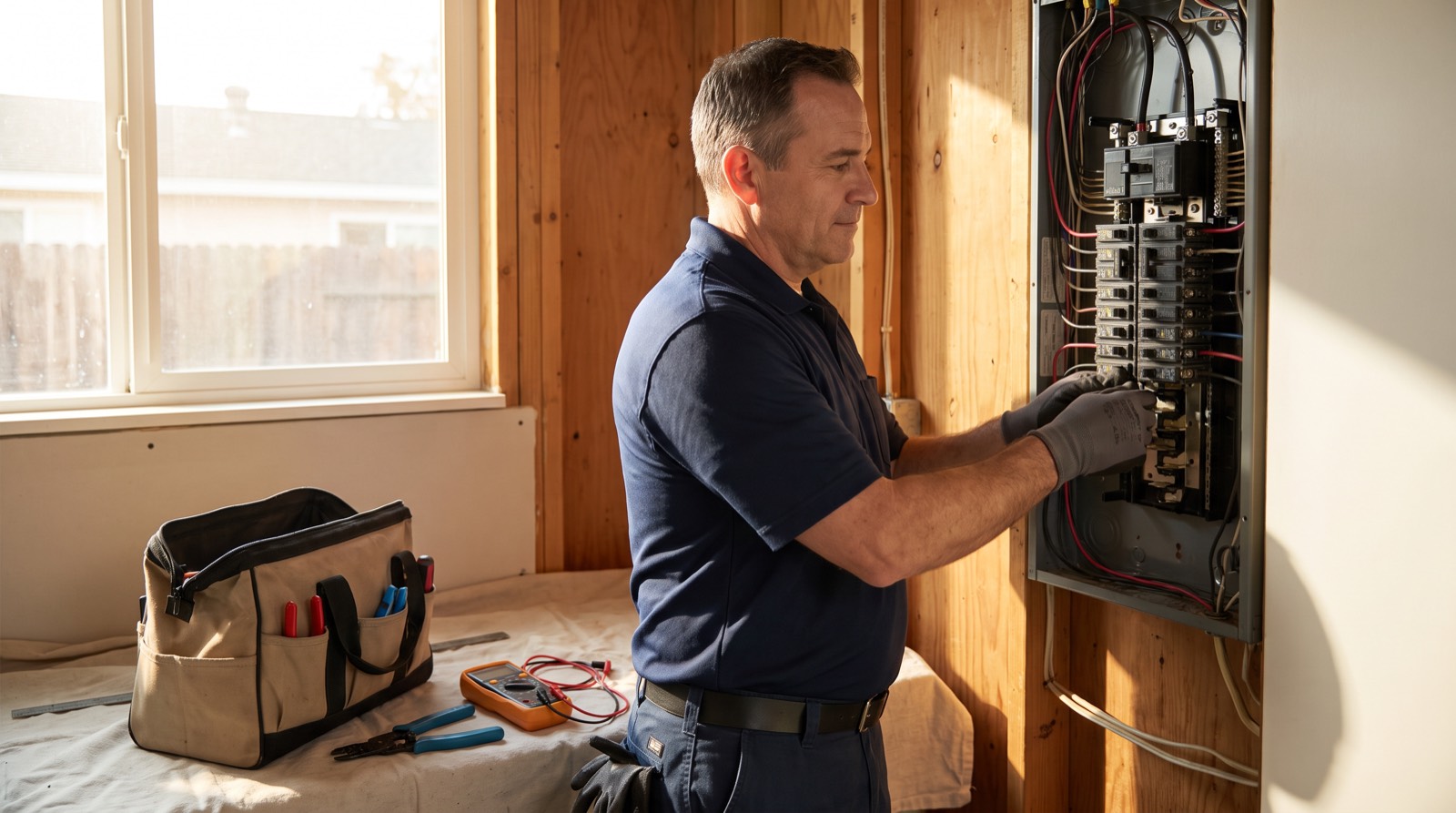
Everything electrical in your house runs through one box, and when that box is undersized, outdated or simply full, you feel it — breakers that trip on a hot afternoon, and no room to add the circuit you actually need. We install modern 100A, 200A, and 400A panels with clear labeling, proper grounding, and permits pulled and inspected.
Electrical Panel Installation you can count on
A panel replacement is the one electrical job where almost every decision is made before anyone picks up a tool. Get the load calculation right and the rest of the work is straightforward. Get it wrong and you have either paid for capacity you will never use, or installed a brand-new panel that is already too small for the heat pump you are planning next spring.
We start by adding up what the house actually draws — heating and cooling, water heating, range and oven, laundry, the general lighting and receptacle load — and then we ask what you intend to add. An EV in the driveway, a hot tub on the deck, a shop in the detached garage and an ADU out back are all loads that belong in the calculation today, not in a second service call two years from now.
From there it is a known sequence: pull the permit, coordinate the outage with PG&E, set the new panel and service entrance, land every circuit on a correctly sized breaker, label the directory so the next person can read it, and get it inspected. You keep the old panel photos, the load calculation and the signed-off permit when we leave.
What we handle
- New and replacement main panel installations
- Proper breaker sizing and neat, labeled circuit layout
- Coordination with PG&E for meter and service work
- Permitting and final inspection handled for you
Signs it is time to call
- Breakers trip on ordinary days
- Not during a storm and not with a shop vac on a ladder — on a normal afternoon with the AC and the oven running. That is a capacity problem, and adding a bigger breaker to the same panel makes it a fire problem instead.
- The panel is full
- No open slots, or slots filled with tandem breakers crowded in to buy space. If there is nowhere to land a new circuit, every future project on the house is blocked behind the panel.
- It is a Zinsco or Federal Pacific Stab-Lok
- Both have long-documented histories of breakers that fail to trip under fault. If you have one, we will tell you plainly, and we will show you the label rather than asking you to take our word for it.
- Warmth, buzzing, or a burnt smell
- A panel should be silent and cool to the touch. Heat at the cover, a hum you can hear in a quiet room, or any scorch mark around a breaker means stop and call today.
- You are planning an EV charger, heat pump or ADU
- These are the three loads that most often turn a working 100A service into an undersized one. It is cheaper to size the panel once than to do the job twice.
How the job runs
- Load calculation and walk-throughWe total the existing load, look at the service entrance, meter and grounding, and talk through what you plan to add. You get a recommendation with the arithmetic behind it, not just a number.
- Permit and utility coordinationResidential panel and service work is permitted work. We file with the authority having jurisdiction for your address and schedule the disconnect and reconnect with PG&E so the outage lands on a day that suits you.
- Installation dayPower down, old panel out, new panel and service entrance set, grounding and bonding brought up to current code, and every branch circuit landed on a properly sized breaker. Most single-family replacements are a one-day job.
- Labeling and documentationA legible directory that names rooms and appliances rather than saying "lights". You should be able to kill the right circuit in the dark without a phone flashlight and a guess.
- InspectionWe meet the inspector, walk the work, and handle any correction on our time. You get the signed-off permit for your records — which matters the day you sell the house.
What moves the price
We do not publish a flat number for work we have not looked at — a quote made from a web page is a guess, and guesses get corrected on invoice day. These are the things that genuinely change what your job costs:
- Whether you are replacing like-for-like or upgrading the service size at the same time
- Service entrance condition — overhead versus underground, and whether the mast, meter socket and conductors are reusable
- How far the panel sits from the meter, and whether the run is accessible
- Grounding and bonding: older homes frequently need a proper ground rod and water-bond brought to current code
- Panel location changes, which turn a replacement into a relocation with new conduit and conductors
- Circuits that need AFCI or GFCI protection under current code once they land on a new panel
- Permit fees for your jurisdiction, and whether PG&E has to do any work on their side of the meter
Two houses on the same street can differ by thousands on the same nominal job, almost always because of the service entrance and the grounding. That is why we look before we quote.
What this means on the Central Coast
Atascadero and the North County run a lot of housing stock from the sixties and seventies on overhead services, and a fair number of rural properties on long underground runs from a pole at the road. Both change the job. Closer to the water — Morro Bay, Cayucos, Cambria, Los Osos — salt air gets into meter sockets and service equipment, and corrosion we find at the entrance often turns out to be the real reason a panel has been misbehaving. We would rather find that on the estimate than on installation day.
Frequently asked questions
How long does a panel installation take?
Most residential panel replacements are completed in a single day, including the utility coordination and inspection scheduling.
Do I need a permit to replace an electrical panel?
Yes. Panel and service work is permitted and inspected work everywhere on the Central Coast. We pull it, we meet the inspector, and you keep the signed-off record. An unpermitted panel is a problem that surfaces at the worst possible moment, which is usually escrow.
How long will my power be off?
For a straightforward single-family replacement, most of a working day. We schedule the utility disconnect and reconnect in advance so the outage is planned rather than open-ended, and we will tell you before we start what the realistic window looks like for your house.
Should I go to 200A or stay at 100A?
The load calculation answers it, not a rule of thumb. That said, if an EV charger, a heat pump, or an ADU is anywhere in your plans, 200A is usually the cheaper decision over the life of the house — because the expensive part is not the panel, it is doing the service work twice.
Can you install a generator interlock or transfer switch at the same time?
Yes, and it is the sensible time to do it. Adding backup provisions during a panel replacement costs far less than returning to open the same equipment up again later.
Do you serve areas beyond Atascadero?
Yes. We provide electrical panel installation throughout the Central Coast, including Paso Robles, San Luis Obispo, Templeton, Morro Bay, and the Five Cities — all from our base in Atascadero.
Are you licensed and insured?
Yes. Good Neighbors Electric is a CA C-10 Licensed Electrical Contractor, License #1124560, fully insured, and every job is done to code with permits and inspections handled for you.
Related services
Electrical Panels & Service Upgrades
Need electrical panel installation?
Call (805) 610-5530 or request a free estimate. Honest answers, clean work, and no pressure — the way a good neighbor should treat you.