EV Chargers & Energy Systems
EV Charger Installation
A Level 2 home charger turns overnight into a full battery, but it needs a dedicated 240V circuit sized to your service. We run a load calculation, install the correct circuit and charger, and make sure your panel can handle it.
EV Charger Installation you can count on
A Level 2 charger is a straightforward installation on a house that has the capacity for it, and a more interesting conversation on a house that does not. Since almost nobody knows which of those they own, that is where we start — with a load calculation rather than a product recommendation.
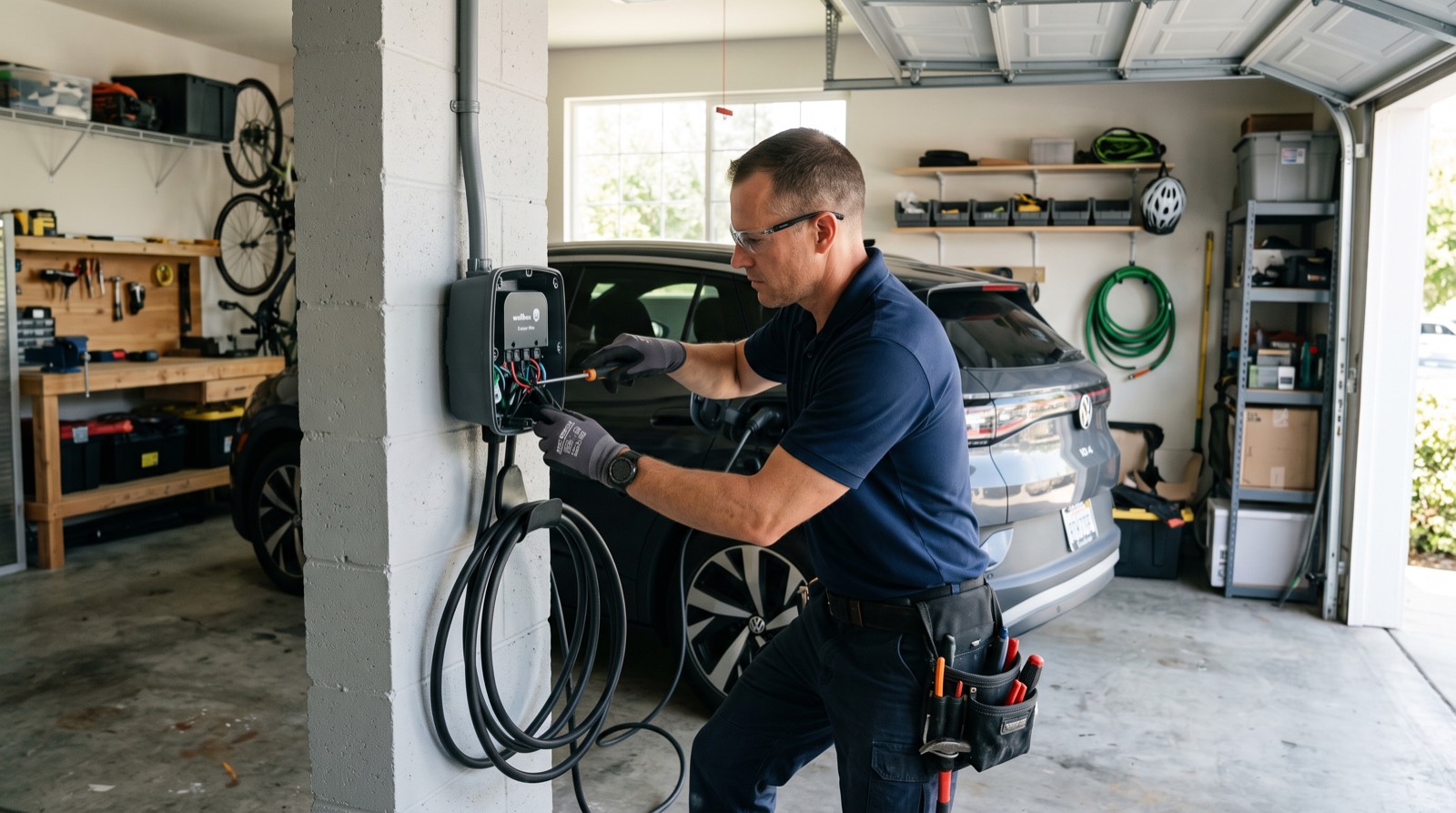
The install itself is a dedicated 240V circuit from the panel to wherever the car parks, sized for the charger and the distance. What makes one quote different from another is almost never the charger. It is the route: how far the run is, whether it crosses a finished ceiling or an attic or the outside of a stucco wall, and whether the panel has room for the breaker once the calculation is done.
We install hardwired units and receptacle-fed units, and we will tell you which one suits your situation rather than which one we happen to stock. Hardwired is generally the better outcome outdoors and for higher-amperage units; a receptacle can make sense where you want the flexibility to take the charger with you.
What we handle
- Level 2 (240V) charger installation
- Load calculations before we quote
- Hardwired and NEMA 14-50 outlet options
- Panel upgrades when capacity requires it
Signs it is time to call
- You are charging on a standard household outlet
- It works, slowly, and it was never intended as a daily high-current load. Older receptacles and back-stabbed connections in particular are not built for hours of continuous draw.
- Your panel has no spare capacity
- A full panel or a tight load calculation does not necessarily mean no charger. Load management and a properly sized circuit can often solve it without a full service upgrade.
- A second EV is coming
- Two vehicles change the calculation and the layout. It is far cheaper to plan the second circuit while the wall is open for the first.
- The car parks a long way from the panel
- Detached garages, carports and long driveways are common here, and the run is the job. Worth measuring before anyone quotes.
How the job runs
- Capacity checkLoad calculation on the existing service, and an honest answer about whether you need anything upgraded before the charger goes in.
- Route and locationWe walk the run with you — where the car actually parks, which side the charge port is on, cable length, and the cleanest path back to the panel.
- PermitEV charger circuits are permitted work in California. We file it, and the inspection protects you as much as it protects us.
- InstallDedicated circuit, correctly sized conductors and overcurrent protection, weather-rated equipment where the unit lives outside, neat routing and a tidy finish at both ends.
- Commission and hand overWe energise, test, get the unit onto your Wi-Fi if it has an app, and run a charge session with you standing there.
What moves the price
We do not publish a flat number for work we have not looked at — a quote made from a web page is a guess, and guesses get corrected on invoice day. These are the things that genuinely change what your job costs:
- Distance from the panel to the charger, which is usually the largest variable
- Route difficulty — open crawlspace and attic are straightforward; finished walls, stucco and slab crossings are not
- Available panel capacity, and whether load management hardware avoids a service upgrade
- Hardwired versus receptacle-fed, and the amperage the unit is rated for
- Indoor versus outdoor installation and the weather-rated equipment that follows from it
- Whether a second charger or a future second circuit is being roughed in at the same time
- Permit fees for your jurisdiction
If you want one number to watch, it is the length of the run. A charger on the garage wall directly behind the panel and a charger at the end of a detached carport are not the same job, however identical the hardware.
What this means on the Central Coast
EV adoption on the Central Coast has run ahead of the housing stock, and a lot of what we see is a modern car parked at a house whose service was sized for a 1972 lifestyle. Rural properties add distance; coastal properties add weather exposure, and a charger mounted where it takes salt air deserves proper outdoor-rated equipment rather than the cheapest enclosure that fits.
Frequently asked questions
Where should I install my EV charger?
Usually on the garage wall nearest your electrical panel and your parking spot — the shorter the run, the lower the cost. We help you choose the best location.
Do I need a permit for an EV charger?
Yes. A Level 2 charger is a new dedicated circuit and that is permitted, inspected work in California. It is also worth having: the permit record is what tells a future buyer, and your insurer, that the circuit was done properly.
Can I get a charger without upgrading my service?
Often, yes. Load management devices and correctly sized circuits solve a great many borderline cases without touching the service. We run the calculation first and tell you honestly which situation you are in.
Hardwired or plug-in?
Hardwired is generally the better long-term installation, particularly outdoors and at higher amperages, because there is no receptacle to age or loosen. A plug-in unit makes sense if you may take the charger with you or want to swap hardware easily. We install both and will give you a straight recommendation for your situation.
Can you install a charger at a detached garage?
Yes. It becomes a question of the feed to that building and whether it has the capacity, which we work out as part of the calculation rather than discovering on installation day.
Do you serve areas beyond Atascadero?
Yes. We provide ev charger installation throughout the Central Coast, including Paso Robles, San Luis Obispo, Templeton, Morro Bay, and the Five Cities — all from our base in Atascadero.
Are you licensed and insured?
Yes. Good Neighbors Electric is a CA C-10 Licensed Electrical Contractor, License #1124560, fully insured, and every job is done to code with permits and inspections handled for you.
Related services
EV Chargers & Energy Systems
Need ev charger installation?
Call (805) 610-5530 or request a free estimate. Honest answers, clean work, and no pressure — the way a good neighbor should treat you.